
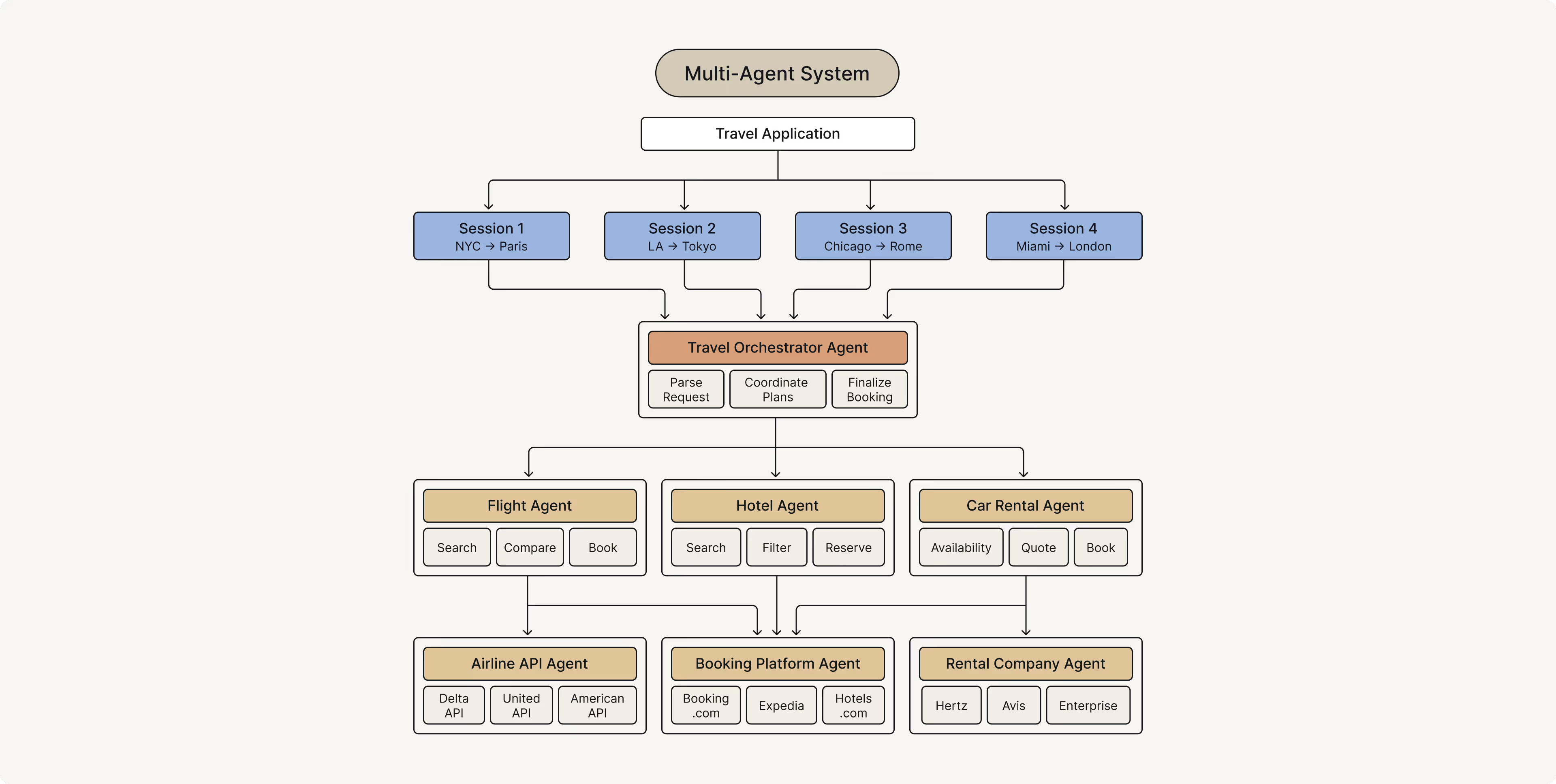
Core Terminology
Agent
An autonomous AI system that can plan actions, make decisions, interact with tools, and learn from experience. Agents operate through a cognitive loop of thought, action, execution, reflection, and alignment.Multi-Agent System
A distributed system where multiple AI agents coordinate to accomplish complex workflows. Each agent maintains its own state, reasoning, and tool interactions while communicating and collaborating with other agents.Trace
A complete record of an agent’s execution path, including all decisions, tool calls, and outcomes for a specific task or session. Traces capture the full context of agent behavior.Span
An individual unit of work within a trace, representing discrete operations such as tool invocations, API calls, or agent-to-agent communications. Spans form the building blocks of hierarchical observability.Session
A bounded interaction context containing multiple agent executions, typically representing a complete user request or workflow that may involve multiple agents and numerous traces. Also known as a conversation.Tool Call
An agent’s invocation of external capabilities, APIs, or functions to accomplish specific tasks. Tool calls represent the bridge between agent reasoning and real-world actions.How Fiddler Provides Agentic Observability
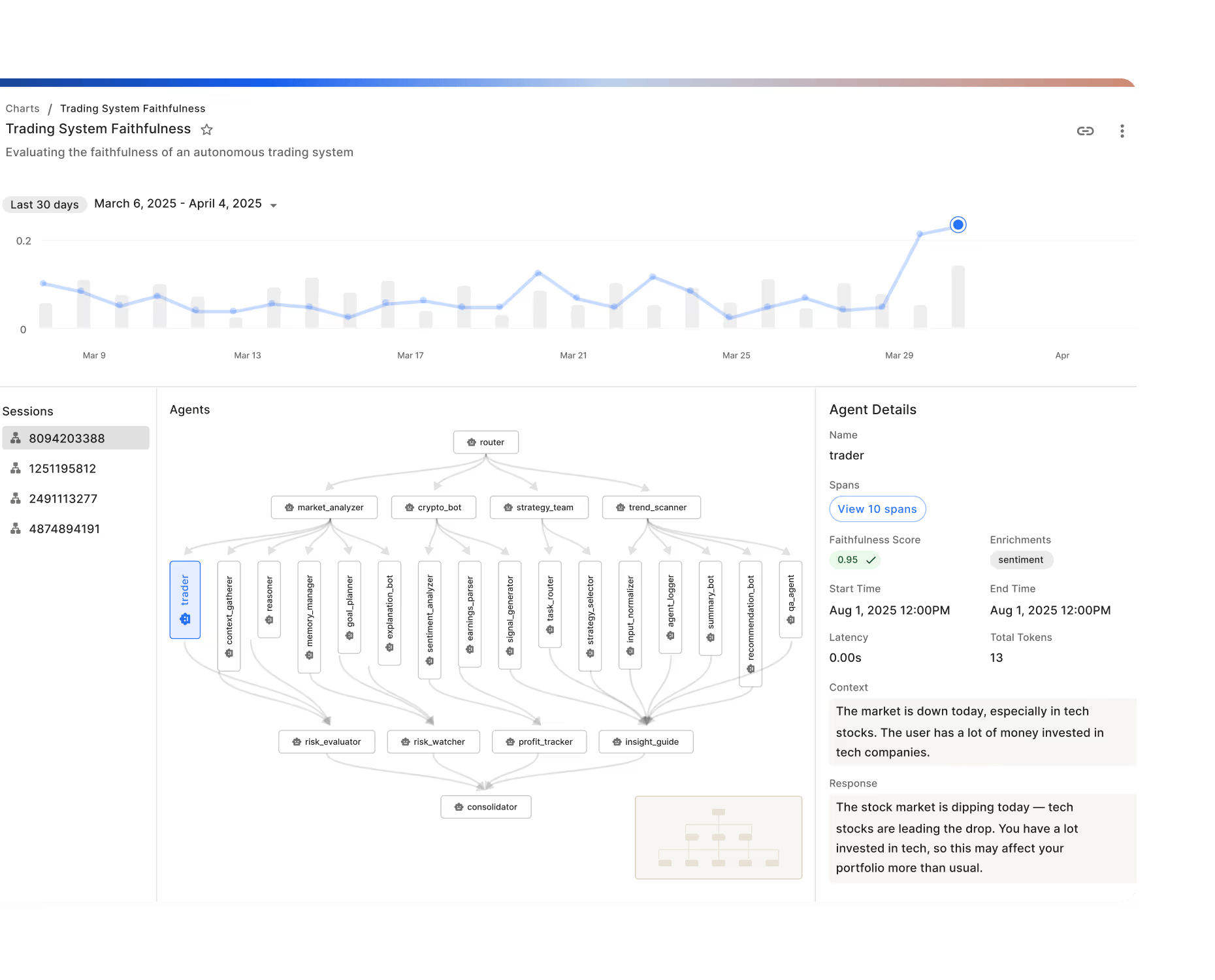
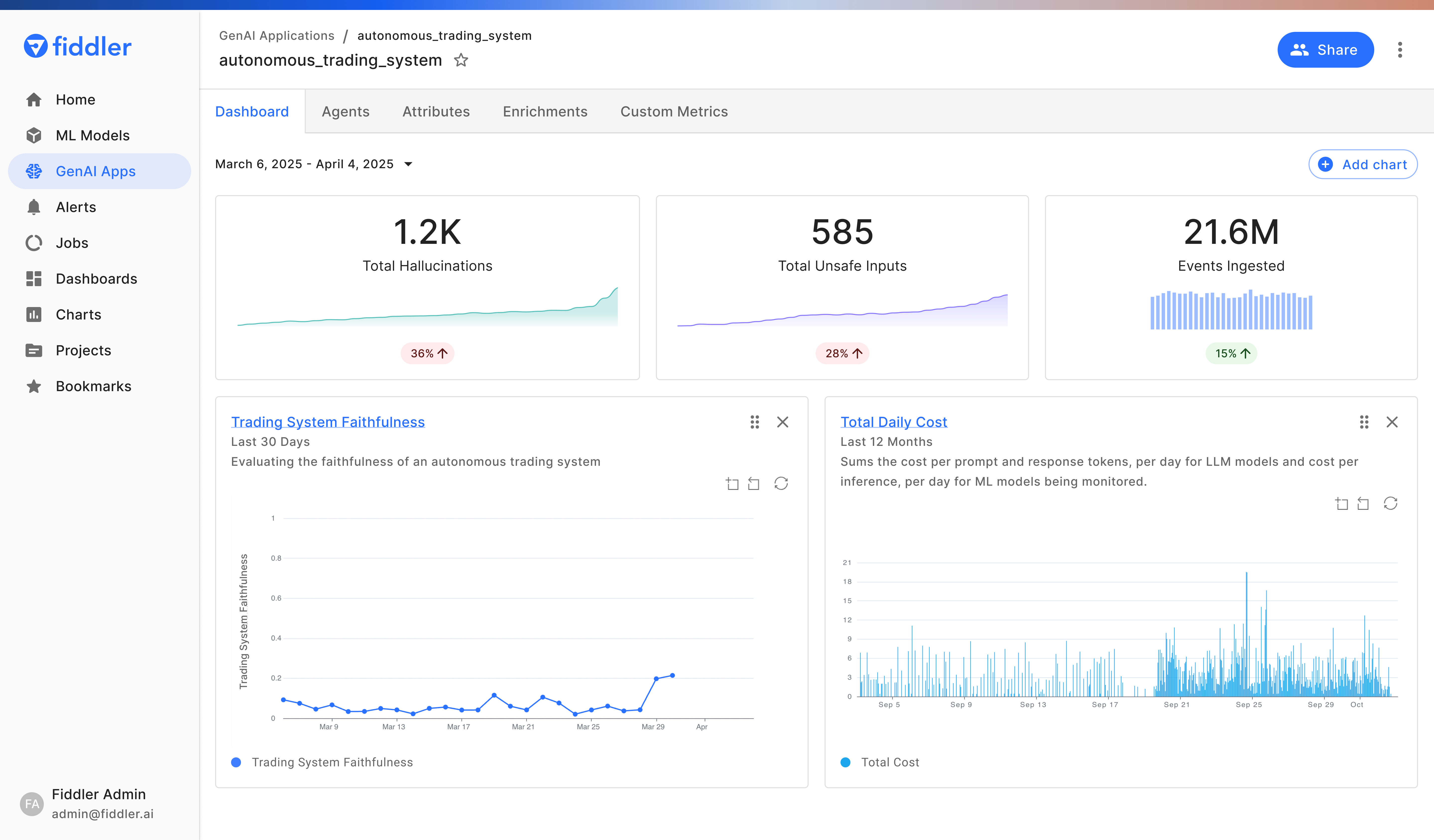
Fiddler’s Agentic Observability platform delivers comprehensive monitoring for multi-agent systems through a hierarchical approach that captures data across multiple layers: 1. Application Layer: High-level system health metrics, aggregated performance indicators, and cross-agent dependencies 2. Session Layer: User interaction contexts, workflow orchestration patterns, and end-to-end request tracking 3. Agent Layer: Individual agent performance, reasoning traces, decision paths, and behavioral patterns 4. Action Layer: Granular tool calls, API interactions, execution results, and timing metrics The platform integrates with leading agentic frameworks (LangGraph, Strands, custom agents) and provides:- Hierarchical Root Cause Analysis: Drill down from application-level issues to specific agent decisions or tool failures
- Semantic Tracing: Capture not just what agents do, but why they make particular decisions
- Cross-Agent Visibility: Monitor coordination, information flow, and dependencies between agents
- Real-time Behavioral Analysis: Detect off-policy behavior, coordination failures, and goal misalignment
Hierarchical Root Cause Analysis
Aggregated Metrics
Why Agentic Observability Is Important
As enterprises deploy multi-agent systems for critical business processes, the complexity of monitoring increases exponentially, requiring up to 26 times more monitoring resources than single-agent applications. Agentic Observability addresses several critical challenges:- Debugging Complexity: Multi-agent systems generate extensive reasoning traces, tool logs, and decision paths that traditional APM tools cannot effectively parse or correlate.
- Trust and Compliance: With 90% of enterprises citing security, trust, and compliance as top concerns for agentic AI, comprehensive observability enables policy enforcement and regulatory adherence.
- Cascading Failures: Errors in one agent can propagate through dependencies, making root cause analysis essential for system reliability.
- Performance Optimization: Understanding agent decision-making patterns enables teams to optimize workflows, reduce unnecessary tool calls, and improve response times.
- Alignment Verification: Ensures agents operate within defined boundaries and adhere to business objectives, preventing autonomous systems from deviating from intended behavior.
The Agent Lifecycle: Five Observable Stages
Fiddler breaks down agent observability into five critical stages that form a continuous feedback loop:- Thought (Ingest, Retrieve, Interpret): Captures prompt processing, memory retrieval, belief state formation, and goal interpretation
- Action (Plan and Select Tools): Monitors decision operationalization, tool selection logic, and execution sequencing
- Execution (Perform Tasks): Tracks tool invocations, API calls, input/output traces, latency, and success/failure signals
- Reflection (Evaluate and Adapt): Observes self-critique processes, trajectory scoring, error analysis, and adaptive learning
- Alignment (Enforce Trust and Safety): Implements guardrails, Centor Model evaluations, and human-in-the-loop interventions
Types of Agentic Observability
- Development-Time Observability: Trace and debug multi-agent systems during development to identify coordination issues, optimize workflows, and validate agent behavior before production deployment.
- Runtime Performance Monitoring: Track operational metrics including agent latency, tool call efficiency, resource utilization, and throughput across distributed agent deployments.
- Behavioral Analysis: Monitor agent reasoning patterns, decision consistency, goal achievement rates, and adaptation mechanisms to ensure aligned autonomous behavior.
- Coordination Monitoring: Observe inter-agent communication, information handoffs, task delegation patterns, and collaborative decision-making in multi-agent systems.
- Trust and Safety Monitoring: Implement continuous evaluation of agent outputs against safety policies, compliance requirements, and ethical guidelines with real-time intervention capabilities.
Challenges
Implementing effective Agentic Observability presents unique technical and operational challenges:- Data Volume and Complexity: Multi-agent systems generate massive amounts of hierarchical data across reasoning traces, tool logs, and coordination events, requiring sophisticated data management strategies.
- Semantic Understanding: Unlike traditional metrics, agent decisions require semantic interpretation to understand the “why” behind actions, not just the “what.”
- Real-time Processing: Agents operate at high speed with complex interdependencies, demanding low-latency observability that doesn’t impact system performance.
- Cross-Agent Correlation: Tracing causality across multiple autonomous agents with asynchronous interactions requires advanced correlation algorithms and timestamp synchronization.
- Dynamic Adaptation: Agents that learn and adapt their behavior over time make it challenging to establish stable baselines for anomaly detection.
- Privacy and Security: Monitoring agent reasoning and data flow must strike a balance between comprehensive visibility and data privacy requirements, as well as security constraints.
Agentic Observability Implementation How-to Guide
- Establish Observability Architecture
- Design hierarchical data collection across application, session, agent, and action layers
- Implement a unified telemetry pipeline supporting both infrastructure metrics and semantic traces
- Configure data retention policies, balancing granularity with storage costs
- Instrument Agent Frameworks
- Integrate observability SDKs with your agentic framework (LangGraph, Strands, custom)
- Capture agent lifecycle events: thought formation, tool selection, execution, reflection
- Implement correlation IDs for cross-agent tracing
- Define Behavioral Baselines
- Establish expected agent behavior patterns and decision boundaries
- Configure anomaly detection for off-policy actions and coordination failures
- Set performance thresholds for latency, success rates, and resource usage
- Implement Hierarchical Monitoring
- Create dashboards with drill-down capabilities from the system to the span level
- Configure alerts for both technical failures and semantic misalignments
- Enable real-time root cause analysis workflows
- Deploy Trust and Safety Controls
- Integrate Centor Models for output validation and safety scoring
- Implement guardrails for real-time intervention on policy violations
- Configure human-in-the-loop escalation for critical decisions
- Establish Continuous Improvement
- Analyze agent performance trends and optimization opportunities
- Use reflection data to identify systematic improvements
- Iterate on agent coordination patterns based on observed bottlenecks